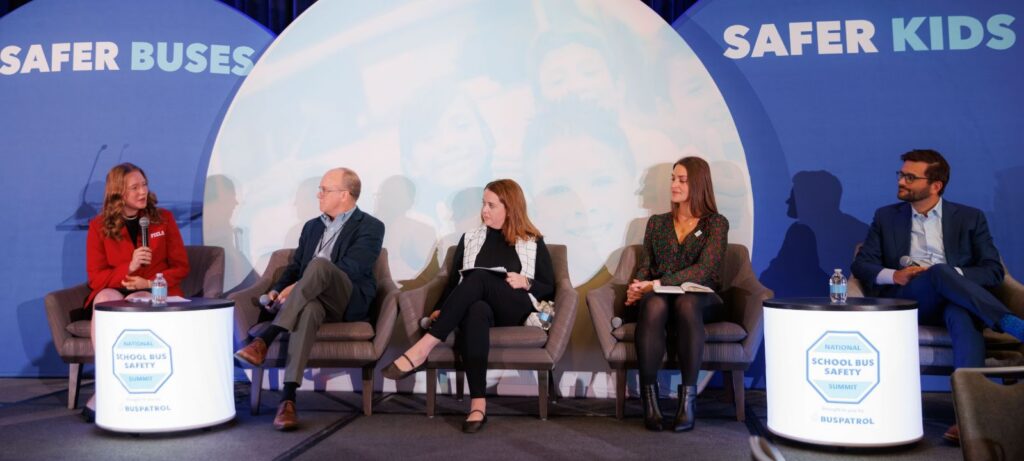
Whether illegal school bus passings continue to grow or decline is determined by an entire safety ecosystem, from education and public awareness to enforcement, engineering, and policy. That systems-level approach anchored the third expert panel discussion at the 2025 National School Bus Safety Summit, where leaders in education, public safety, infrastructure, and advocacy examined how lasting behavior change depends on far more than enforcement alone.
Convened in Washington, D.C., by BusPatrol alongside the Governors Highway Safety Association and Safe Kids Worldwide, the Summit brought together national, state, and local partners to move from discussion to a clear, actionable roadmap for student safety. This session focused on the role communities play in that roadmap, highlighting how education, public trust, and cross-sector collaboration create the conditions for programs to succeed long term.
Meet the Panel
- Sutton Sherrard, National Student Vice President of Programs, Family, Career and Community Leaders of America
- Russ Rader, Chief Communications Officer, Insurance Institute for Highway Safety
- Emily Davidson, Director, Ohio Traffic Safety Office
- Marisa Jones, Managing Director, Safe Routes Partnership
- Ryan Monell, Executive Vice President, Government Operations, BusPatrol
Emily Davidson of the Ohio Traffic Safety Office emphasized that safe student mobility requires a true systemwide approach, with emergency response, law enforcement, and even the insurance sector working in alignment. Safe Routes Partnership’s Marisa Jones connected that thinking back to the student experience, noting that school bus safety is fundamentally pedestrian safety, because every child becomes a pedestrian the moment they step on or off the bus.
Leveraging the student perspective, panelists agreed that long-term success depends on public trust, particularly when it comes to automated enforcement. Russ Rader of the Insurance Institute for Highway Safety warned that programs quickly lose political and community support when they are seen as revenue generators instead of safety measures. Reinvesting funds directly into traffic safety, he noted, is essential to maintaining credibility and keeping the mission centered on protecting children.
Speakers also called for collective advocacy at the state level, so safety mandates are backed by strong regulatory frameworks and the funding needed to handle the administrative demands of enforcement.
Take Action: Download the National School Bus Safety Action Plan
What came out of the National School Bus Safety Summit is a clear path forward. The National School Bus Safety Action Plan, developed in partnership by the Governors Highway Safety Association and BusPatrol, equips decision-makers with the data, strategies, and policy framework to effectively deploy programs, strengthen laws, and change driver behavior.